Tales of Research Misconduct by Hub Zwart
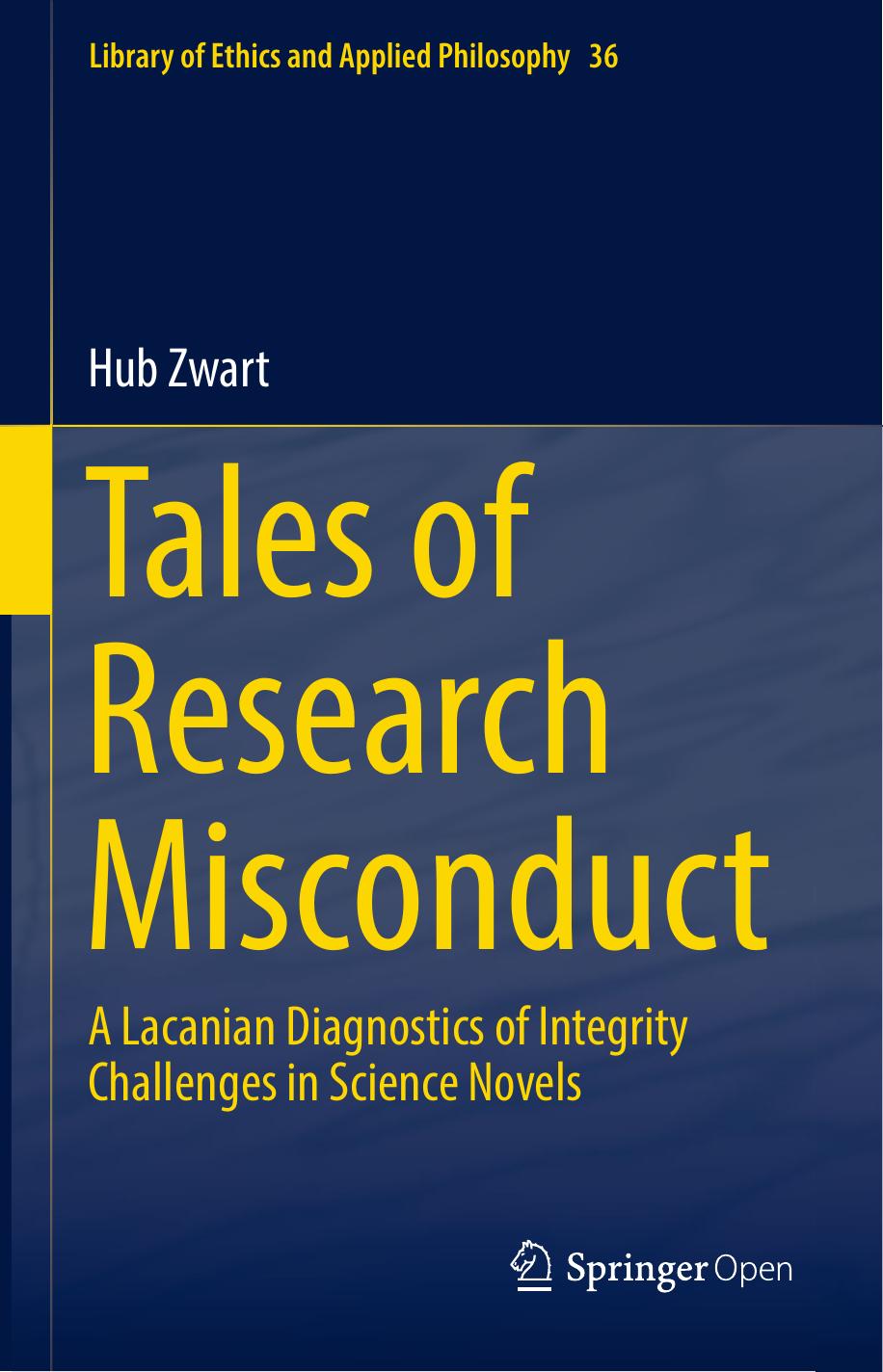
Author:Hub Zwart
Language: eng
Format: epub, pdf
Publisher: Springer International Publishing, Cham
This type of discourse tends to be disruptive, but may nonetheless be functional. By challenging the “impossible” epistemic regime represented by Gottlieb, a less disruptive practice of knowledge production could perhaps emerge (S2 in the lower-right position). But in order to achieve this, Martin (the divided subject) must work through the question what is really driving his research, his cupido sciendi (a in the lower-left position). And precisely this self-reflective deficit is Martin’s ἁμαρτία, his tragic fatal flaw. In order to analyse his experiences, he is in need of a therapist. Upon his return to New York City, he bursts into Gottlieb’s office to make a full–fledged “confession”: “I did not add to knowledge. I did the humane thing. I lost sight of science”. But this attempt to establish an analytical relationship falters, because he can’t get through to Gottlieb anymore, who has become senile, so that Martin cannot be “cleansed” (p. 422). Unable to accept his father’s place and become his substitute (the position of department head is offered to him, which would reposition him as S2 in the upper-left position), he flees from McGurk for good, taking his microscope with him – an item which functions as a phallic symbol, an enabling contrivance, complementing his deficiencies – to follow a fugitive colleague into the forest.
This final gesture seems a final escape into Cynicism (in the ancient sense), for Cynics were itinerant scholars who already refused all societal roles and responsibilities, which they saw as enslaving, as indicated by their garment: bare feet and a rough cloak (Dudley 1967). Martin’s escape into the forest conveys his refusal or inability to accept endorsement by the professional, institutional, symbolic order. After the death of the father, Martin flees from the role he is expected to play, as well as from the claustrophobic embrace of his wealthy spouse, who mothers him and bereaves him of what is left of his independence. Beyond the civilised world, he wants to come to terms with his own desire. But should we see his “forest science” as an attempt at self-analysis, or rather as a relapse into the position of beautiful soul, a misguided effort to restore his integrity by withdrawing into “pure” science, rather than by trying to work-trough the inevitable conflict?
Download
This site does not store any files on its server. We only index and link to content provided by other sites. Please contact the content providers to delete copyright contents if any and email us, we'll remove relevant links or contents immediately.
Unwinding Anxiety by Judson Brewer(73421)
The Art of Coaching by Elena Aguilar(53650)
The Fast Metabolism Diet Cookbook by Haylie Pomroy(21256)
Rewire Your Anxious Brain by Catherine M. Pittman(18797)
Healthy Aging For Dummies by Brent Agin & Sharon Perkins RN(17123)
Talking to Strangers by Malcolm Gladwell(13537)
The Art of Thinking Clearly by Rolf Dobelli(10719)
Mindhunter: Inside the FBI's Elite Serial Crime Unit by John E. Douglas & Mark Olshaker(9521)
Crazy Rich Asians by Kevin Kwan(9418)
The Compound Effect by Darren Hardy(9150)
Tools of Titans by Timothy Ferriss(8593)
Periodization Training for Sports by Tudor Bompa(8417)
Becoming Supernatural by Dr. Joe Dispenza(8368)
Wonder by R. J. Palacio(8240)
Bodyweight Strength Training by Jay Cardiello(8029)
Crystal Healing for Women by Mariah K. Lyons(8007)
Change Your Questions, Change Your Life by Marilee Adams(7931)
Nudge - Improving Decisions about Health, Wealth, and Happiness by Thaler Sunstein(7852)
Should I Stay or Should I Go? by Ramani Durvasula(7780)
